
I met a photography master.
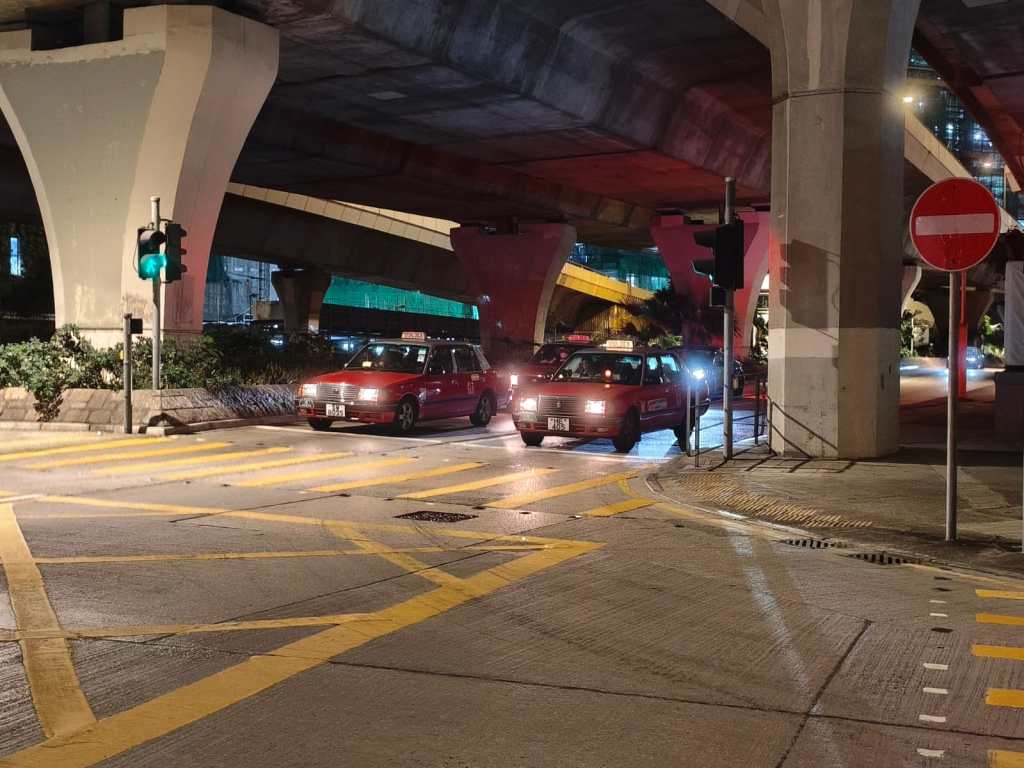
The sad master
One month ago, I was having lunch at a Vietnam Style restaurant near the public library. The food wasn’t bad, but something caught my attention.
I saw a man that bore the resemblance of the local photography maestro I saw in a documentary video.
“Is he the photography maestro that turned into a taxi driver? “, I thought.
(For people who don’t know me, I have a special skill – I am extremely good at recognizing human faces. )
Not wanting to make any mistakes, I waited and kept observing the gallant man sitting in front of me.
After a while, I was very sure he was the person I was looking for. I stood up and walked to his table. He was shocked when I mentioned his name.
“Are you Dick Chan? I watched the documentary and I love your work very much! The one in the Chai Wan fire station. “
He looked extremely nervous. It seemed like he didn’t like to be called as a photographer.
“Yes. I took the photos from the little window of my small studio. But I rarely do any photography job anymore.”
Sensing the awkwardness in the air, I returned to my seat. When he left the restaurant, he greeted me, and his large figure disappeared from my sight.
The cruel facts of being a professional photographer/videographer
1. Many people underestimate how much work it takes to become a professional photographer
In the eyes of outsiders (including myself before writing this post), photography is an easy job that only requires expensive equipment, a fancy portfolio, strong networking skills, and experience. They believe that anyone can make a living with a SONY A7 III (including a flashlight) or IV after 3 to 6 months of “training.”
With this mindset, clients without prior experience often set very low rates to hire a photographer. Without any knowledge or idea about quotations, novice photographers use these opportunities to build their portfolios; sometimes they even lower their rates to get the offers. Soon, the novices discover that they don’t enjoy photography anymore, as there are so many changes and demands from clients.
In one sentence: when you turn your hobby into work, it is not fun anymore—unless your “hobby” is “work.”
2. Professional photography and videography are for tough people with excellent physical strength, especially videography
Cameras are heavy. Lenses are heavy. Everything is heavy in this industry.
According to my own experience, some photographers bring a suitcase to a professional photography event (usually, they will include a small chair if they are short).
Apart from the weight of the tools, without good physical strength, a photographer won’t be able to endure long hours of shooting or deal with the accidents and drama happening at the events. An experienced video producer told me that he made a lot of documentary videos when he was young, but he can’t do it now that he is old.
“Documentary production is extremely exhausting.”
Also, one point is overlooked by many people: the post-production process requires photographers/videographers to spend long hours in front of the monitor. Obviously, this will cause significant damage to their eyesight, but the changes suggested by clients will also drive photographers crazy.
(Still, we haven’t mentioned delayed payment in the industry, but it exists in other industries too.)
In my case, since I knew that if I became a videographer, my eyesight would get worse (I have eye floaters already), I decided to treat it as a hobby only.
3. Actually, photographers don’t earn a lot of money in Hong Kong.
Out of boredom, I used Apify to collect data from a Facebook group designed for hiring freelance photographers. Then I asked Gemini to calculate the average hourly pay of each job. Here is the result:
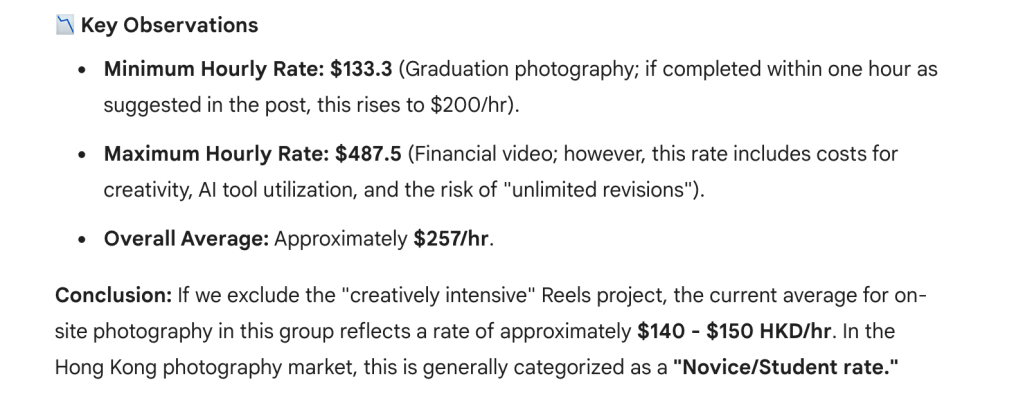
Although the platform itself might be biased regarding the hourly rate, I was surprised by the result. On the surface, $257 HKD (equal to $32.79 USD) doesn’t seem too bad. However, if we include the time needed for adjusting the light and color of the photos, the actual rate is lower than $257.
Meanwhile, a photographer won’t work like a 9-5 worker every day. Even if you become a photography assistant, the hourly pay is quite low in Hong Kong. Veteran photographers in Hong Kong say that apprentice photographers can’t even make enough money to support themselves for the first 10 years of their careers.
No wonder people say it is a perfect career for nepo babies in Hong Kong. OH, I nearly forgot how pricey professional cameras are (but you can rent a professional camera).
Wait… You may wonder: Should I still pursue my dream and step into this field? To be honest, if you are not scared by my words and are strong, healthy, have good eyesight, and don’t need to worry about money
go for it!!!!!!
Even though it is going to be very tough, you will see a lot of interesting things and people on this journey. During different events, I could see a lot of photographers, and they were like black panthers waiting for their prey in the corner. Their adaptiveness and concentration in the setting left me in awe.
Most importantly, rarely could I find the same kind of passion and energy in the eyes of a white-collar worker, regardless of their position or salary level.
PS: Now I have a new hobby, or you could say a calling from somewhere unknown 😂. I want to learn everything about freelancers, the freelance market, and the gig economy. I will share insights and latest trends in the market. Hope my audience will not disappear. 😂 I will continue posting my photos and life updates on this website. Hahaha.

Leave a Reply